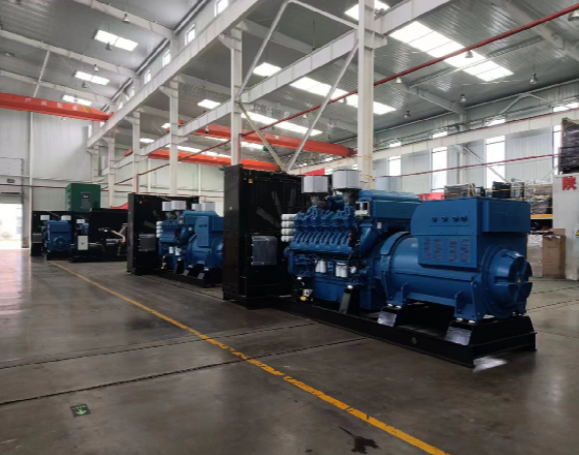
The problem of persistent instability
The grid fails, and a 50 kva generator must bear the night without mercy. Facilities designed for continuous prime power often face voltage sag, frequency drift, and sudden load steps that turn a stable generator set into a jittering liability. Operators who switch to a dedicated 480V generator have felt that relief — but only when the alternator, AVR, and control logic are tuned for long, steady runs rather than short backup bursts.
Real-world wake-up: why this matters now
When Hurricane Maria left nearly all 3.4 million residents of Puerto Rico without power in 2017, hospitals, telecom hubs, and water treatment plants depended on on-site prime power for months. That exposure revealed two truths: sustained operation exposes design flaws that brief tests do not, and field crews need predictable behavior from gensets over weeks rather than hours. Load bank cycling, harmonic distortion and synchronization problems became daily battles in that aftermath.
How EvoTec targets the weaknesses
EvoTec approached the problem like a surgeon. They isolated transient response and governor tuning as primary failure vectors and redesigned control maps for continuous duty cycles. The result is tighter frequency regulation, reduced thermal stress on the prime mover, and smarter alternator cooling paths. Where older sets saw voltage drift under heavy reactive loads, EvoTec’s AVR logic maintains voltage within narrow bounds while limiting excitation current to reduce winding temperature rise.
Technical pieces that matter in the field
Key elements worth noting: improved AVR tuning, adaptive governor curves, and phased synchronization routines that prevent shock loading during parallel operations. EvoTec also integrates onboard data logging to capture load steps and transient events, letting engineers trace harmonic sources and insulation heating before a failure. These aren’t flashy add-ons — they are the core fixes that keep a 50 kva generator running as a continuous prime power asset rather than a temporary bandage.
Deployment realities and common mistakes
Installers often repeat the same errors: sizing solely by peak wattage, neglecting harmonics from modern power electronics, or skipping routine load bank testing. A site that thought a 40kva unit would suffice finds itself overtaxed when non-linear loads spike; conversely, oversizing without attention to cooling and fuel management invites wet-stacking and carbon buildup. Consider test cases: a rural clinic that replaced a failed set with a 40kva 3 phase generator only to discover the AVR wasn’t tuned for motor-start currents — downtime continued until controls were reworked. Learning the limits of alternator cooling and specifying correct synchronization logic saves weeks of painful field fixes.
Metrics that prove the point
Measureable gains follow concrete fixes: lower frequency deviation during 50% step loads, reduced stator temperature rise under 80% continuous duty, and fewer unscheduled shutdowns per 1,000 run-hours. EvoTec’s field logs show these improvements not as marketing copy but as recorded events — load transients caught, post-event adjustments logged, failure modes halted before escalation.
Advisory — three golden rules for selecting continuous prime power solutions
1) Match control architecture to duty cycle: insist on governor and AVR maps rated for continuous prime operation, not just standby modes. This prevents chronic frequency drift and limits excitation stress.
2) Validate with realistic load bank tests and harmonic scans: perform motor starts and non-linear load cycles during commissioning to reveal hidden instabilities. Record events and review the alternator thermal profile.
3) Prioritize maintainability and diagnostics: choose systems that log transients, show insulation trends, and allow remote parameter updates. That visibility stops field guessing and forces corrective action before failure.
These rules lead to fewer surprises and measurable uptime improvements — and when the night is long, that matters. EvoTec. —