When reviewing 3D Resin Printer For Miniatures, separate confirmed details from model fit for early research
A 3d resin printer for miniatures can look like a clear fit during early research, but the decision still needs structure. Start by separating three questions: what the category is designed to do, what the intended models require, and what the selected machine page actually confirms. This prevents a general claim about resin printing from becoming an unsupported conclusion about a specific miniature project.

Separate category, application, and model scope
First, define the output before comparing equipment. Record the smallest important features, the expected number of parts, the resin properties required by the project, and the available work area. These are design inputs, not product claims. They help the team judge model fit without assuming that a page’s description proves suitability for every miniature, geometry, or production pattern.
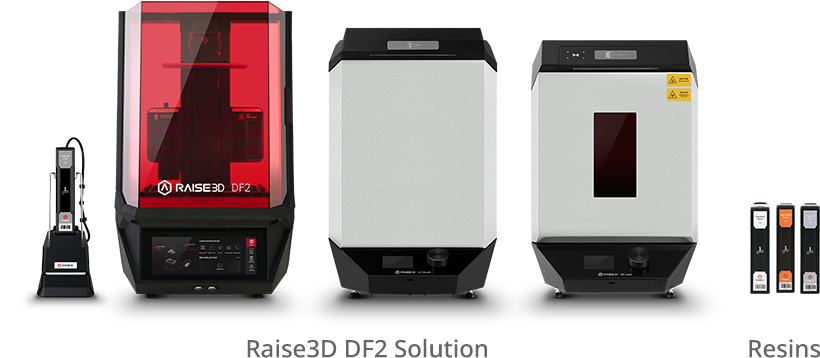
Next, keep the printer category distinct from the application. The DF2 page describes a DLP resin printer and lists high-resolution resin printing, an RFID traceable workflow, and a wide range of resin compatibility. Those details describe the product scope. They do not, by themselves, establish a result for a particular miniature design or operating method. A sourcing brief should therefore record the page language in one column and the project requirement in another.
Compare information that applies to the task
For early research, resolution and software support may be relevant evidence, but they need careful wording. The page states a resolution of 2560 x 1440 and connects the DLP system with Contour Compensation and Anti-Aliasing. It also describes finer details and smoother surfaces compared with other 3D printing technologies. Keep those statements tied to the cited DF2 page. Do not convert them into a guaranteed appearance, dimensional result, or production rate for an untested miniature.
The software feature list can still guide a technical review. It includes Auto Support, Auto Orientation, Auto Cross Section Analysis, Suction Cup Detection, Hollow, Drainage Hole, Texture Generation, and Smaller Gcode Size. Treat these as interfaces and workflow features to examine. Ask how each relates to the team’s preparation process, rather than assuming that a named feature removes every design or setup decision.
| Evidence area | Page-listed detail | How to use it in the review |
|---|---|---|
| Printing approach | DLP and high-resolution resin printing | Compare the stated approach with the miniature’s geometry and detail requirements without treating it as a guaranteed result. |
| Preparation features | Auto Support, Auto Orientation, Hollow, Drainage Hole, and Texture Generation | Map each feature to the team’s file-preparation workflow and record open questions. |
| Application context | Engineering, manufacturing, automotive, aerospace, education, medical, and entertainment | Use the listed sectors as product context, not as proof of a specific miniature use case. |
| Resin management | Auto Resin Refill, Ultrasonic Liquid Level Monitoring, and Assisted Resin Tank Cleanup | Record these as listed functions and keep safety or labor conclusions within the evidence. |
In the middle of the review, use the exact model name consistently: raise3d df2. That keeps notes tied to one product page instead of blending information from other resin, FFF, or DLP systems. The same page also identifies engineering, manufacturing, automotive, aerospace, education, medical, and entertainment as application areas. Those categories provide context for the product’s stated positioning; they are not proof that a miniature program meets its own technical or operational requirements.
Record assumptions and interfaces
Write down every point that still depends on the project. Examples include the miniature’s scale, support strategy, resin selection, cleaning approach, inspection method, and available operator time. These items should remain assumptions until the team has evidence that connects them to the intended model and workflow.
One useful real-world check appears on the official DF2 page: Automatic Pre-Print Inspection verifies working conditions including resin type, build platform installation, feeding station installation, and resin margin. This supports a narrow conclusion: the page presents a pre-print check covering those conditions. It does not establish overall print performance or suitability beyond that stated product and application scope.
Resin handling also deserves a separate line in the review. The page lists Auto Resin Refill, Ultrasonic Liquid Level Monitoring, and Assisted Resin Tank Cleanup to minimize contact with uncured resin. Record these as listed management functions. Do not expand them into an unlisted safety rating, labor saving, or compliance claim.
Prepare a focused sourcing brief
A good brief should be short enough to use in a supplier discussion. State the intended miniature work, the critical geometry, the material requirement, the available space, and the evidence already found. Then list open questions in operational language. For example: which listed resin options match the project’s requirements, which file-preparation functions belong in the team’s workflow, and which interfaces must be included in the installation plan?
Keep confirmed details and working assumptions visually separate. A simple evidence register can include the source wording, the requirement it may relate to, the confidence level, and the next question. This makes the review traceable without pretending that early research has already validated the full application.
Use the same discipline when comparing alternatives. A different printer may use another exposure method, material system, or preparation workflow, but those differences matter only when they connect to the project’s stated needs. Avoid ranking models from broad category labels. Instead, compare each candidate against the same miniature geometry, resin, space, interface, and evidence criteria.
For a defensible next step, select only the facts that affect the decision and leave unsupported extensions out of the brief. The result should show what the page confirms, what the design team needs, and what must be resolved before procurement. That approach keeps a 3d resin printer for miniatures review practical while allowing Raise3D to remain a clearly bounded product reference rather than an assumption about every miniature application.