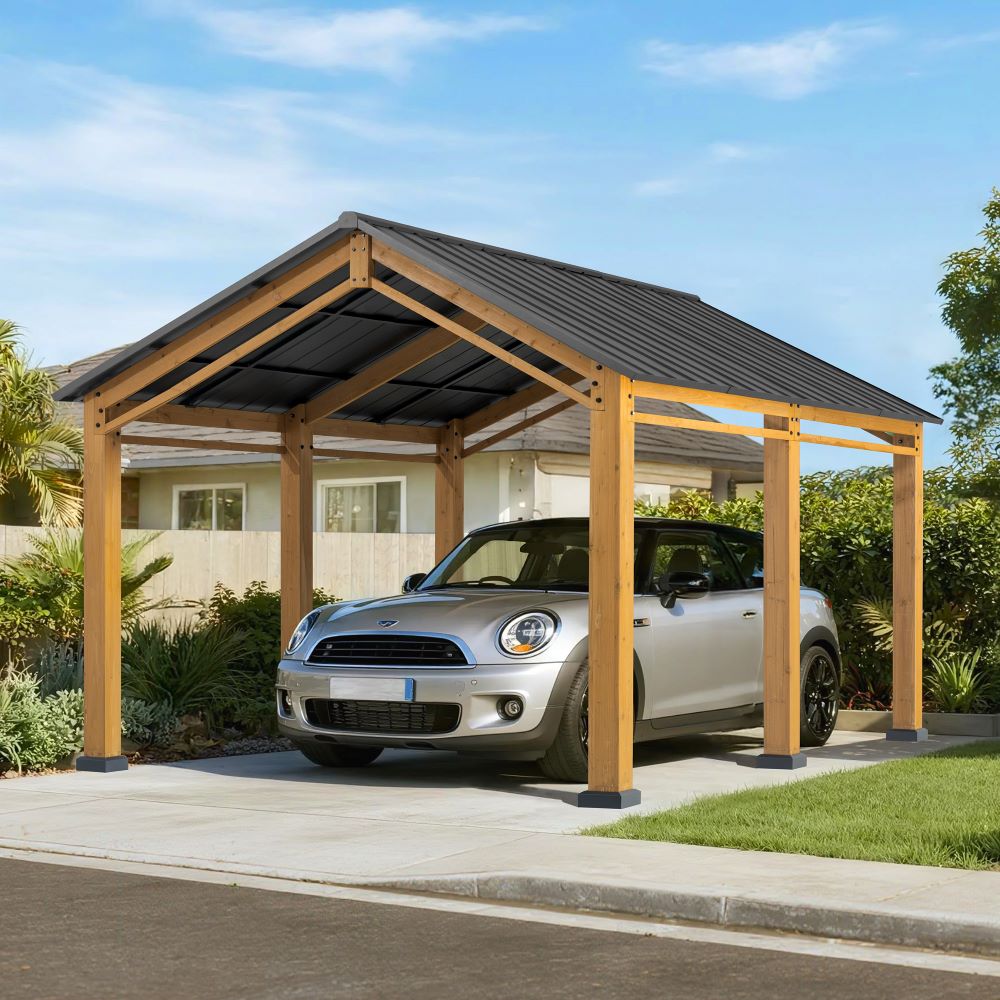
Set up your comparison of Sunjoy Carports around vehicle, trailer, or RV dimensions for seasonal equipment storage
SUNJOY carports are easier to compare when the starting point is the vehicle and the space around it. For an RV owner, that means recording the stored vehicle’s full length, width, and height before reviewing product details. Include mirrors, roof equipment, ladders, a hitch, and any attached seasonal gear that will remain in place. Then measure the available site, including the approach path and the room needed to open doors or walk around the vehicle. These measurements describe the storage problem. They do not, by themselves, confirm that a particular model will fit.

Start with the routine, not the product name
Consider how the covered space will be used through the season. A vehicle that moves frequently needs a clear entry and exit route. A trailer or RV stored for longer periods may need room for access along one or both sides. Seasonal equipment can change the layout as well. Folding chairs, bins, tools, or outdoor supplies may need to sit beside the vehicle rather than underneath it.
Write down the dimensions in a simple order: vehicle length, vehicle width, vehicle height, available width, available length, and available height. Add the clearance you want around the parked vehicle as a separate note. This prevents a common comparison error: treating the vehicle’s dimensions as the same thing as the space required for storage. Also record slopes, trees, fences, gates, and nearby structures. These site conditions affect how the space can be approached and used, even before a product is considered.
Connect measurements to product choices
Once the site is documented, compare the type of shelter with the routine it must support. A roof can address overhead coverage, but the useful footprint includes the space needed to enter, park, unload, and move around the vehicle. A trailer may require attention to the hitch and turning path. An RV may require attention to roof-mounted equipment and side access. If seasonal equipment will share the area, decide whether it belongs under the shelter, beside it, or in a separate storage zone.
When reviewing metal carport kits, separate the product page’s stated details from your own planning assumptions. The SUNJOY collection describes kits as including pre-cut parts, hardware, and step-by-step instructions. That information helps define what the package is presented to contain. It does not establish the dimensions, layout, assembly conditions, or fit of every model. Those details should be treated as model-specific decisions rather than inferred from the collection description.
| Page-listed point | How it helps the review | What not to infer |
|---|---|---|
| Pre-cut parts, hardware, and step-by-step instructions are described as included in the kits. | Record the stated package contents for the selected model. | Do not infer dimensions, fit, or assembly conditions from the package description. |
| Steel frames and weather-resistant roofing are described as features of metal carports. | Use these statements as product-page details in the materials section of the comparison. | Do not extend a collection-wide description into a guarantee for every model or site. |
| Carports are discussed for vehicles, RVs, equipment, outdoor workspaces, shaded patios, and storage areas. | Use the examples to identify the intended storage routine. | Do not infer suitability, dimensions, weather performance, or regulatory approval. |
Material descriptions also need careful handling. The page describes steel frames and weather-resistant roofing as features of metal carports. These are page-listed characteristics, not a reason to assume that every model has the same construction or that a shelter will perform identically in every setting. Use the selected product listing for the details that control your comparison, then match those details against the measurements and routine recorded at the start.
Use the collection page as a bounded starting point
The SUNJOY collection page presents carports for vehicles, RVs, or equipment. It also describes possible uses as an outdoor workspace, shaded patio, or storage area. This broad range of examples can help you identify the main purpose of the covered space, but it should not be read as proof of suitability for a particular RV, trailer, site, climate, or approval requirement. For this comparison, the relevant question is narrower: does the selected model’s stated configuration align with the vehicle dimensions and storage routine?
Portability is another point to define before comparing listings. Decide whether you are planning a fixed seasonal location or expect to change the shelter’s position. Consider the path between the storage area and its intended use, and note whether stored equipment must be moved independently of the vehicle. Avoid treating a general category label as a guarantee of easy relocation. The practical answer depends on the selected model and the conditions of the site.
A short comparison checklist
Keep the final comparison brief enough to use while reading product pages. First, match the listed model dimensions with the vehicle’s full measured envelope, not only its manufacturer-rated body size. Second, account for the approach, door access, hitch area, and side clearance. Third, identify where seasonal equipment will be placed and whether that placement changes the required footprint. Fourth, record which statements come directly from the page and which are your own planning assumptions.
For the product evidence itself, look for three clear categories. Note what the kit is described as including, such as pre-cut parts, hardware, and instructions. Note any stated material or roof descriptions, while keeping those claims tied to the page. Finally, note the intended-use examples without extending them into a promise about fit or performance. This method keeps the comparison useful without filling gaps with assumptions.
Before choosing, create one short record for each candidate: measured vehicle dimensions, available site dimensions, access needs, equipment-storage plan, and page-supported product details. If any of those entries is unclear, the comparison is not finished. A precise record makes it easier to distinguish a model that appears relevant from one that is actually aligned with the planned use.
The best decision is the one that connects the real storage routine to confirmed product information. Start with the RV, trailer, vehicle, and seasonal equipment; then compare the available space with the selected listing’s stated details. Treat general use examples and material descriptions as bounded page evidence, not automatic guarantees. That approach gives SUNJOY a clear place in the comparison without allowing the brand name to replace measurement or model-specific review.